
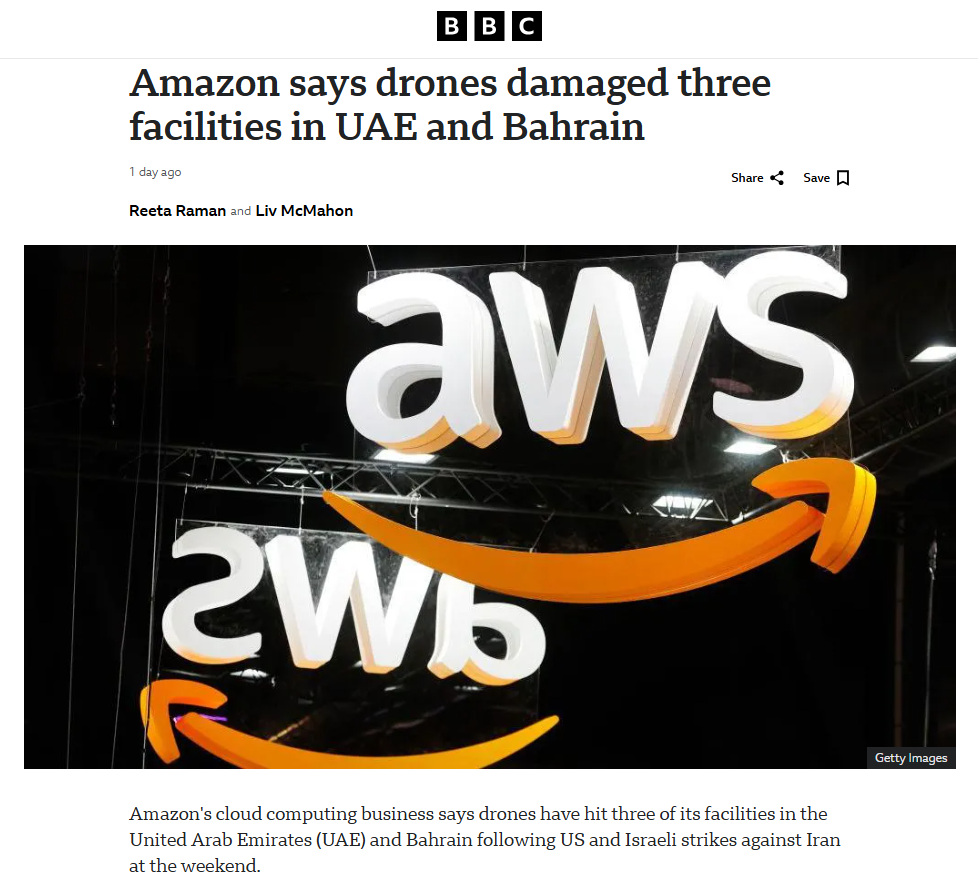
Recent disruptions impacting Amazon Web Services (AWS) infrastructure in the United Arab Emirates and Bahrain have reinforced a hard truth:
Even hyperscale cloud is not immune to real-world risk.
|
|
Cloud regions are still physical data centers. They rely on power grids, fiber routes, cooling systems, and regional stability. When geopolitical tension or infrastructure disruption occurs, the impact is no longer theoretical.
For enterprises operating mission-critical systems, this changes the conversation from “How scalable is the cloud?” to “How resilient is our architecture?”
The Cloud-Only Assumption
Over the past decade, many organizations embraced a Cloud-Only strategy. The assumption was simple:
- Multi-AZ equals safety
- Multi-region equals continuity
- Big provider equals zero risk
But redundancy within a single ecosystem is not the same as architectural diversification.
True resilience requires independence — not just replication.
That’s where Hybrid by Design becomes critical.
The Sovereign Hybrid Cloud Strategy
A modern hybrid architecture ensures:
- Workloads can run both on-prem and in public cloud
- Data sovereignty requirements are preserved
- Recovery objectives are realistic
- Infrastructure is not dependent on a single provider or region
This is where Nutanix delivers significant value.
Nutanix is not just hyperconverged infrastructure. It is a full Hybrid Multi-Cloud platform designed for consistency, automation, security, and portability.
Let’s break down what that means in practice.
What Nutanix Brings to the Table
- Nutanix Cloud Platform (Unified Architecture)
Nutanix provides a single operating model across:
- Private cloud (on-prem)
- Edge environments
· Public cloud
The same hypervisor, storage fabric, networking stack, and management plane operate everywhere. This eliminates architectural drift between environments.
Consistency reduces complexity.
Reduced complexity increases resilience.
- Nutanix NC2 – True Hybrid Cloud Mobility
Nutanix Cloud Clusters (NC2) extends Nutanix directly into public cloud providers like:
- AWS
- Azure
This allows organizations to:
- Lift and shift workloads without refactoring
- Maintain the same architecture across environments
- Burst capacity into cloud during demand spikes
- Failover workloads from on-prem to cloud
Unlike traditional DR setups, NC2 enables cloud as an extension of your data center — not a replacement. That’s architectural flexibility.
- Nutanix Flow – Micro-Segmentation & Network Security
Nutanix Flow provides:
- Micro-segmentation at the VM level
- East-west traffic control
- Application-centric security policies
- Built-in network visualization
- Virtual Private Clouds (VPCs)
- Overlay Subnet & Encapsulation
In a hybrid world, network security becomes complex quickly. Flow ensures consistent policy enforcement across environments.
Security should follow the workload — not the location.
- Built-In Disaster Recovery & Replication
Nutanix supports:
- Synchronous and asynchronous replication
- Near-zero RPO configurations
- Automated failover and failback
- Cross-site and cross-cloud DR
This means you can design:
- Active-Active architectures
- Active-Passive recovery
- On-prem to cloud failover
Resilience becomes engineered — not hoped for.
- Nutanix Automation & Self-Service
With Nutanix Calm and automation capabilities, enterprises gain:
- Blueprint-based application deployment
- One-click provisioning across environments
- Policy-based scaling
- Automated DR orchestration
Automation reduces human error during crisis events — when speed and precision matter most.
Because during outages, manual processes fail first.
- Sovereign & Regulatory Alignment
For regions like the Middle East, data sovereignty is increasingly critical.
Nutanix enables:
- Full control over data residency
- Private cloud isolation
- Regulatory compliance alignment
- Independent operational continuity
You can keep sensitive workloads on-prem while leveraging public cloud elasticity for non-critical systems.
That balance is strategic.
The Bigger Lesson
The recent AWS regional disruption is not about criticizing hyperscale’s.
It’s about acknowledging reality:
No provider can eliminate geopolitical risk.
No region is immune to instability.
No architecture should depend entirely on one ecosystem.
Cloud-first was the strategy of the last decade.
Hybrid-by-design is the strategy of this one.
Final Thought
Availability is not about where your workloads run.
It’s about how intelligently they’re designed to move.
Organizations that invest in sovereign hybrid cloud platforms — leveraging solutions like Nutanix NC2, Flow, and automation — are not reacting to outages.
They are engineering resilience in advance.
Because when the cloud goes down, your architecture becomes your real SLA.
 The Hyperconverged Perspective